December 3rd Matters
- But it makes some people uncomfortable

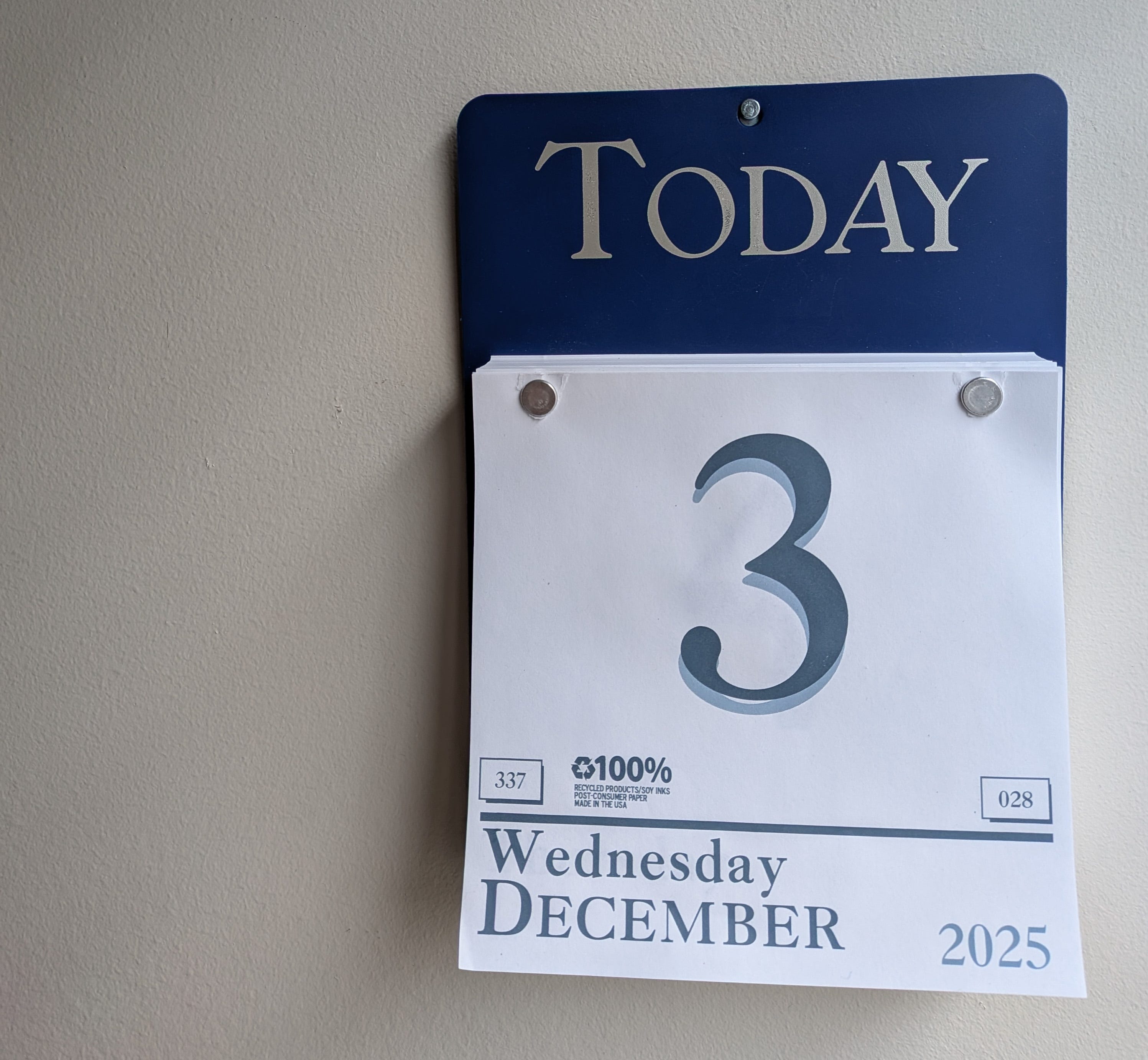
A Day Like Any Other?
A couple of nights ago, I got to open the first little door on my Advent calendar (I never had one growing up, and now I’m making up for that parental oversight). While looking over the dates on all the little doors, and anticipating the Belgian chocolate I expected to find hidden there, I started to wonder if we weren’t becoming overloaded with “special” days.
Of course, we are in the midst of a sort of interregnum between the sovereign holydays of Thanksgiving and Christmas, and so such thoughts are not too surprising given how these days, and the season surrounding them, has great cultural (and commercial) significance in contemporary society. But, even setting aside this particular time of year, I’ve been thinking lately that there are more commemorative days than we can really cope with.
Many of them, to be fair, are just silly and more designed as fodder for local tv news features or mindless radio dj banter, like: International Scented Candle Day, National Wine Tasting Day, Easy Bake Oven Day, or National Cookie Cutter Day. But these do glut the calendar and I worry that they trivialize the need to annually recognize important people and issues in our collective lives.
But lately, some of the important dates – the ones that really matter – have suffered severe political neglect. On Juneteenth (a federal holiday), this year the president of the United States, rather than issue a proclamation about the United States and that sin of slavery, or about the work that we, as a society still need to do, instead posted online that: “[There are] too many non-working holidays costing our Country $BILLIONS OF DOLLARS to keep all of these businesses closed.” Then there was the silence over World Aids Day – I suddenly felt we were back in the days of the Reagan Administration.
This Time It’s Personal
There is yet another special day which I expect to read nothing about. It is neglected by the government, it is also generally ignored by churches (that’s a whole other essay for another time), and it gets almost no publicity on social media. It is the International Day of Persons with Disabilities.
According to the World Health Organization:
The day is about promoting the rights and well-being of persons with disabilities at every level of society and development, and to raise awareness of the situation of persons with disabilities in all aspects of political, social, economic, and cultural life. WHO joins the UN in observing this day each year, reinforcing the importance of securing the rights of people with disabilities, so they can participate fully, equally and effectively in society with others, and face no barriers in all aspects of their lives. ( https://www.who.int/campaigns/international-day-of-persons-with-disabilities )
Given that the current administration has, once again pulled the United States out of the WHO (“You can’t tell us ‘Murican’s what to do!”) it isn’t surprising that this is not something we hear about from federal agencies. Of course, given the administration’s attitude toward the disabled, even if we were still in the WHO, disability issues would not be anywhere near the current government’s radar.
Oh, my God, they’re making me miss Bob Dole! Bob Dole? Yes, even he was an advocate for the disabled. Is this what we’ve come to?
As I have written before, both my parents were blind. I have developed what is now classified as “low vision.” The issues surrounding the relationship of the disabled with the rest of the world has never been far from my consciousness most of my life.
In my experience, the disabled, as a class, are generally looked upon by too many in society, as either objects of pity (“There but for the grace of God…”), or as people whose bodily or mental failings are emblematic of underlying moral failure, or as inspiration porn. Making things accessible and accommodating the needs of the disabled to allow for fuller participation in society has been decried as dystopian by authors ranging from Ayn Rand to Kurt Vonnegut (e.g.: the short story: “Harrison Bergeron”) I also think that the presence of the disabled, for some, is a subconscious and unwelcome reminder of human fragility and perhaps even mortality.
Even if there were greater acknowledgment of International Day of Persons with Disabilities, it would hardly be enough to make a meaningful difference by itself. But at least it would be a start.
Three Experiences: The Good, the Bad, and the … uh… What the Hell Was That?
Over the last few years, I’ve been using a white cane. There are times when my vision isn’t that terrible – or at least, I think I can get by. But even on those days, I miss lots of things. and I risk running into objects (and people). My vision is unpredictable and can be better or much worse in a split second depending on all sorts of conditions. I’ve been told by vision specialists that I’m better off (and safer) using a white cane.
The cane functions both practically and symbolically. It serves to keep me from tripping over objects on the sidewalk I don’t see, and, at the same time, it is a sign that “here is someone with a disability – don’t expect them to see in the same way you do.” On this Day of Persons with Disabilities, I’d like to share just three experiences of day-to-day life. All three took place at museums.
Three years ago, I was visiting Paris with friends. One of the museums we wanted to go to was the Musée de Cluny – the national museum of the Middle Ages. It’s an imposing and beautiful space. Early in my visit, another visitor to the museum took me aside. Between her broken English and my high school French, it was made clear to me that the museum had a tactile map for the visually impaired. While I have some vision (see above), it was extraordinary to be able to discern the location of objects, wall and rooms through my hands. It gave me a much batter understanding of where things are and how they are spatially related. All of this thanks to a random French museum goer.
More recently, I had a less positive experience at a local museum. It prompted me to write the following email which explains what happened:
Good morning,
Yesterday my spouse and I visited your museum for the first time since moving to Chicago last November. I am visually impaired and I use a white cane. This isn’t just to avoid running into things I might not see clearly, but it is also to let others know that I don’t see well. Normally I need to be about a foot away from an artwork to be able to actually see anything more than a blur. Also, in a museum such as yours where no large print versions of the labels are available, my spouse often has to read them for me as the print is small. My spouse usually stands with me so that as she is reading or pointing out things in the painting I might miss, we aren’t so loud as to interfere with the experience of other patrons.
After looking at two or three works on the first floor, an employee came up to us and reprimanded us. We were told to back up and don’t get close to the art. My spouse replied: “But she can’t see very well!” The employee didn’t respond but just stared at us. We continued on. The rest of the time we were on that floor, your employee closely followed us. Such obvious surveillance made me feel as if we were expected to commit a crime at any moment. If I hadn’t been aware of how much my spouse had wanted to visit your museum, I would have left immediately.
Even though I’ve lost a significant amount of vision over the last few years, I still have an abiding love of art. If anything, during this time, my appreciation of the visual arts has only deepened. Visiting museums is still one of my favorite activities. In all those visits I have never felt so humiliated, embarrassed, and unwelcomed. Making a museum accessible and inclusive for the disabled requires more than just a ramp and having handrails next to toilets.
An official from the museum responded a couple of days later. To their credit, they did unreservedly apologize. They added that it is clear that there training for staff had gaps in it and they needed to correct that. I was grateful. I’m not sure I’m emotionally ready to revisit, however.
My most recent experience was at the Art Institute of Chicago. That’s a museum I’m especially fond of. We were there, in part, to see the major exhibition of the works of Gustave Caillebotte. I was by myself, at one point, standing my usual 1 foot (30.5 cm) away from a painting and thoroughly appreciating his use of color and photographic-like attention to framing, when I noticed a woman standing very close beside me. I finally turned to her and with a genuinely quizzical tone, she asked: “Can you see the paintings?”
Suddenly, it was as if time stopped for a moment and dozens of possible replies to this weirdly invasive question came to mind.
“No. I’m here to smell the paintings.”
“No. I listen to the paintings. They talk to me and tell me many things.”
“No, I taste the paintings.”
“Paintings? Paintings!? Aw damn it. I thought this was Burger King. No wonder I haven’t gotten any fries yet.”
Fortunately for everyone, I decided that I’d be much more polite than my questioner.
“Yes. It’s why I stand this close to them.”